Does CI Lead to Job Losses?
“If I improve this process, am I improving myself out of a job?” It’s a question many won’t say out loud, but it shapes how people engage with Continuous Improvement. This blog tackles the uncomfortable truth behind that belief, unpacking where Lean/CI has been misapplied and why job losses are not an inevitable outcome.
METHODOLOGIESLEADERSHIP & MANAGEMENT
Question: Doesn't continuous improvement ultimately lead to job losses? If we remove waste… are we just making people redundant?
If you walk into most organisations and ask people what they really think about Lean or Continuous Improvement (CI), you won’t just hear words like efficiency, flow, or waste reduction. You might also hear in a subtler form: "If I help improve this process… I might be improving myself out of a job."
Let's not dress this up. The uncomfortable truth is regardless as to whether CI should lead to job losses, people have lost jobs as a result of improvement initiatives. There are organisations where CI initiatives has been followed by headcount reductions, restructures (and usually with it, redundancies), hiring freezes, or cost removal based objectives. It's a shame, but when people are resistant to CI initiatives because of the risk of the future, they are not misinformed, they are responding to what they have seen. In practice, this tends to follow two patterns: either improvement is used to justify cost reduction after the fact, or it is tied to cost targets from the outset - both leading to the same outcome.
The uncomfortable truth
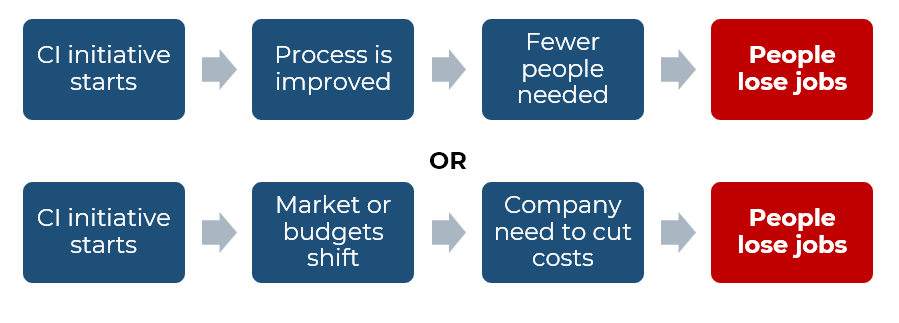
Whether CI intended that or not becomes irrelevant. This is the story that people remember. It’s also worth noting that this isn’t unique to CI You could replace “CI” with almost any organisational change initiative and see a similar pattern emerge. This is an important cycle to identify because if people believe job losses are an inevitable outcome of improvement, then trust erodes, engagement drops, and CI never truly takes hold.
Improvement work will often start revealing duplication, rework, delays, under and over capacity, and in Lean terms, this is waste (muda) - and removing it is exactly the point. But when that philosophy meets real-world pressures such as; efficiency targets, cost constraints, or strategic demands, it often leads to a pivotal leadership question:
"Why are we paying for capacity that we don't need?"
At that moment, what started as a system issue becomes a cost issue. And we all know where cost issues often land. Not because Continuous Improvement says so, but because organisations feel the need to respond financially.
There is both good news and bad news in this...
the good news is that this is not what CI is about, nor is it what it leads to when it is practiced well.
the bad news is that even when organisations get this wrong, it still isn’t CI making that decision. It’s a management choice.
If the uncomfortable truth is that improvement has sometimes been followed by job losses, then this is the point where we need to separate perception from principle. In many ways, I would say stop saying we are trying to "remove waste" but instead we are trying to "add value" to both current and potential end users.
Lean approaches often boil down to a simple idea, it is "about creating needed value with fewer resources and less waste" [1]. In practice, this often means identifying and removing the 8 wastes (Muda).
CI Doesn’t Remove People - It Adds Value
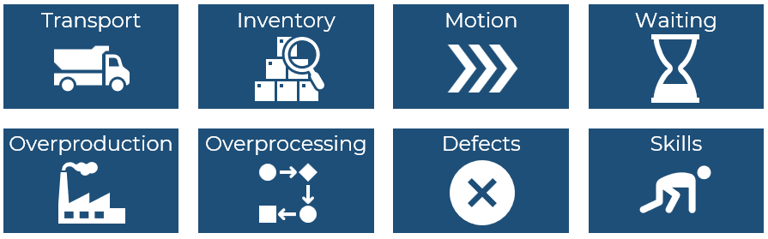
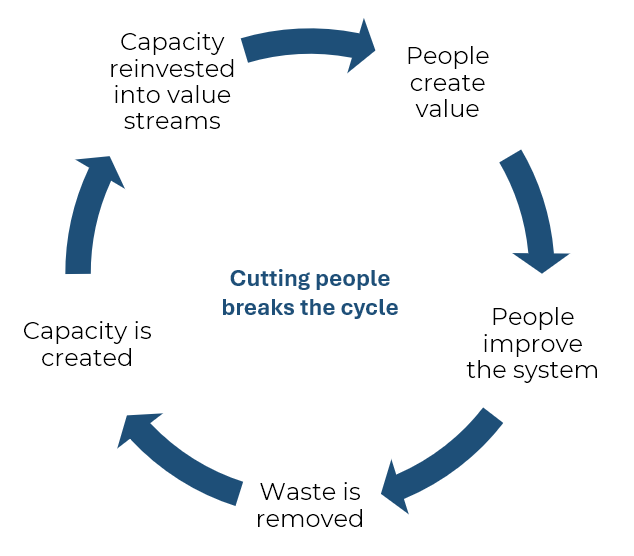
When that waste is removed, something important happens - not redundancies... but capacity. Even where Lean discussions (and Ohno) refer to ‘reducing headcount’, this is fundamentally about reducing the need for labour within a process, not removing people as an end goal.
This is where Lean/CI is often misunderstood. When Toyota developed the Toyota Production System (TPS), it did so in response to economic pressure, not to reduce people, but to avoid loss in all forms. Because here, removing waste does not mean removing people. It means freeing up time, effort, and capability that was previously tied up in non-value-adding activity. And that capacity can be used to:
improve quality
reduce lead times
solve deeper systemic issues
develop people and skills
deliver more value to customers
Now before some of the critics come charging through my optimism bubble, this distinction is not just philosophical, it is supported by evidence. Lean & CI, when studied in practice rather than theory, shows a consistent pattern.
Firstly, there is a clear preference within Lean thinking for continual improvement over layoffs. Research comparing workforce management approaches demonstrates that Lean does not prescribe headcount reduction. Instead, it frames workforce decisions as a management choice, not a Lean necessity. In fact, quantitative models using automotive industry data show that the decision to pursue layoffs versus continued improvement depends on factors such as productivity levels, demand recovery, and shutdown duration. In other words, these are economic and strategic decisions, not outcomes dictated by Lean itself [2].
Secondly, where Lean and CI are applied more holistically in public sectors, rather than defaulting to downsizing, organisations often:
redeploy people into improvement activity
invest in training and capability building
shift capacity towards higher-value work
This is not limited to manufacturing[3]. Public sector applications, including within the UK, have demonstrated that efficiency gains can be reinvested into services, with employees moving into new or expanded roles rather than being removed. In these cases, improvement leads to service enhancement and capacity reallocation, not blanket cost-cutting.
Finally, across sectors - from healthcare to IT and finance - research consistently shows that CI delivers:
improved operational performance
increased customer satisfaction
enhanced organisational competitiveness
However, the public sector also highlights something even more important... CI does not operate in a vacuum. We've applied CI outside of manufacturing time and time again, but we also make sure that people understand that the tools and philosophy requires adaptation to context (which is precisely what Lean is all about) particularly around:
culture
governance structures
funding models
and how “value” is defined
For example, in government settings; value is not just efficiency, but also accountability, fairness, and societal outcomes. What appears to be “waste” may actually serve critical legal or democratic functions and incentives can sometimes discourage efficiency if it leads to reduced future funding. All of this is crucial because it reinforces that outcomes are not driven by CI alone, but by the system it operates within [5].
Above all, these benefits are achieved through better use of existing capability, not simply reducing it. The gains come from improving how work is done, not from doing the same work with fewer people. So when CI or Lean is applied as intended, the outcome is not a smaller workforce. It is a more capable one that is delivering more value, with greater adaptability. One of the core problems I have observed in many organisations, is leaders will often use CI to diagnose inefficiency (highlighting waste, delays and duplication) but then don’t always follow through on what to do next, because eliminating waste is harder than identifying it.
If CI creates capacity rather than redundancies, then the obvious question is: What happens to that capacity? And this is where the narrative often shifts, and where CI itself steps out of the picture. Because at this point, the organisation is no longer dealing with a CI issue, it's dealing with a leadership decision.
When waste is removed and processes improve (or markets and budgets shift), organisations are left with a choice. Broadly speaking, it comes down to two options:
Option 1: Extract the cost
reduce headcount
lower short-term operating costs
deliver immediate financial savings
Option 2: Reinvest the capacity
redeploy people into higher-value work
invest in capability and skills
solve more systemic problems
improve service, quality, or growth potential
expand your product or service offering
Both are valid decisions in a business context. But only one is aligned with the intent of CI and this is where pressure starts to shape behaviour. Practically, something I have seen quite often is many organisations that make short‑term headcount cuts find themselves re‑employing staff when demand returns or paying substantially higher rates for consultants to fill the gap; that premium, plus recruitment and retraining costs, often outweighs the short‑term payroll saving. Treating redundancies as a simple cost‑cutting lever is often short‑sighted: it converts a flexible capacity problem into a cycle of churn, higher contingency spend, and legal exposure.
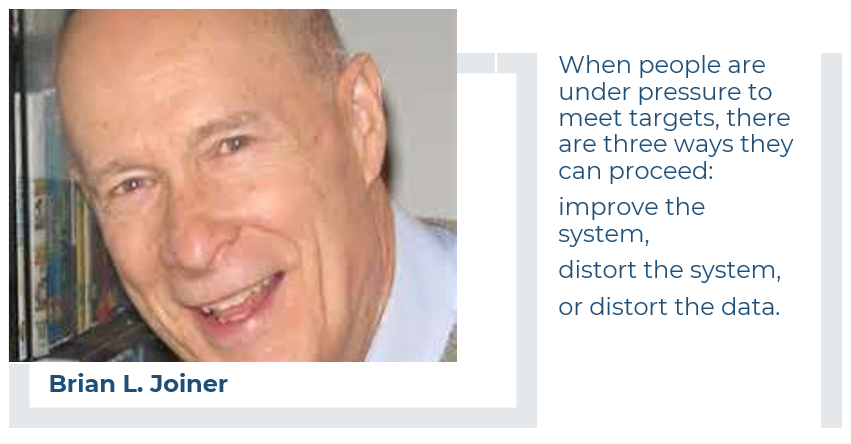
In the words of Brian Joiner, "When people are under pressure to meet targets, there are three ways they can proceed:
improve the system,
distort the system,
or distort the data.”
CI is fundamentally about the first of these, improving the system. But when organisations place disproportionate pressure on short-term cost or efficiency targets, the risk is that attention shifts to the second or third. Here is where many organisations unintentionally undermine their own improvement efforts. Because if the default response to increased efficiency is to remove people, a clear message is sent - "Improvement = job losses" - and once that belief takes hold, the consequences are predictable. People become less willing to; surface problems, suggest improvements, engage in change, or support leadership decisions.
Not because they don’t care or are naturally resistant, but because the perceived personal risk is too high. Let's not even get into the circular argument that the best improvements come from the people who do the work, and If your goal is to remove the people who do the work, your source of improvement will eventually disappear.
What Happens Next Is a Leadership Decision
Lean and CI are often misunderstood as cost-cutting tools. They’re not. At their core, they are systems for seeing clearly, revealing where value is created, where it is lost, where capacity exists, and where the system is holding itself back. It doesn’t remove people, it removes the need to waste their potential. It is not a solution in itself. It is a mirror. And sometimes, what that mirror shows is uncomfortable. It exposes inefficiencies, underutilised capacity, and opportunities to do things differently. But what it doesn’t do is tell you what decision to make next. That part is down to leadership.
With that said, sometimes to really change the way your organisation thinks and acts, some old practices sometimes need to be reduced, and if that leads to literal role redundancies, early retirement benefits, voluntary (and only voluntary) redundancy or other incentives may be useful to do this initial shift. But in real practice, as you free up more and more valuable time for people through improvements, our leadership mindset should be to avoid removal of jobs by potentially; cutting overtime, removing temporary workers or outsourced labour, use people more wisely, redeploying into suppliers or connected organisations for them to further promote improvement (and yes, that also means making my role as a CI consultant more and more redundant!).
CI will not decide to reduce headcount. It will not choose to reinvest in people. It will not prioritise short-term savings over long-term capability. Those decisions sit firmly with the people leading the organisation. So the question is not:
“Will CI lead to job losses?”
The real question is:
“What kind of organisation do we choose to be when we see the opportunity to improve?”
Do you want to treat improvement as a way to reduce cost, or as a way to build capability?
Remember that people are one of the few assets that appreciate in value, there is a reason why TPS and Lean Transformation puts people in the middle of the picture. Because in the end, CI doesn’t dictate the outcome, but it makes the choice impossible to ignore.
So, after all of this, we come back to the original question - does CI actually lead to job losses?
"Many people think that Lean is about cutting heads, reducing the work force or cutting inventory. Lean is really a growth strategy. It is about gaining market share and being prepared to enter in or create new markets."
Ernie Smith - University of Tennessee
Lean Enterprise Institute (2022). What is lean? [online] Lean Enterprise Institute. Available at: https://www.lean.org/explore-lean/what-is-lean/.
C. R. A. Hallam, S. Hammond, and W. Flannery, “Comparative analysis of work force management techniques between Lean and traditional manufacturing companies: A quantitative decision tool for choosing between layoffs and continual improvement,” pp. 1–11, July 2010.
M. saroya -, “Integrating Lean Manufacturing and Six Sigma: A Synergistic Approach to Enhance Quality and Operational Efficiency,” International Journal For Multidisciplinary Research, vol. 6, no. 5, Oct. 2024, doi: 10.36948/ijfmr.2024.v06i05.29727.
H. E. Golor, S. N. Fawedikimo, A. H. Adeoye, E. I. Duhu, O. F. Dosunmu, and H. M. Shobajo, “Assessing the Impact of Lean Six Sigma Management on Organisa-tional Productivity,” Traektoriâ Nauki, vol. 11, no. 6, pp. 1015–1015, June 2025, doi: 10.22178/pos.119-28.
N. Maarse and M. Janssen, “The Need to Adjust Lean to the Public Sector,” pp. 54–65, Sept. 2012, doi: 10.1007/978-3-642-33489-4_5.
References
Syniad CI Ltd.
VAT Registered in UK.
Registered: 11329238
Contact Us
enquiries@syniad.uk
+44 292 277 2786
Our Trusted Collaborators